
Antistatic agent additive
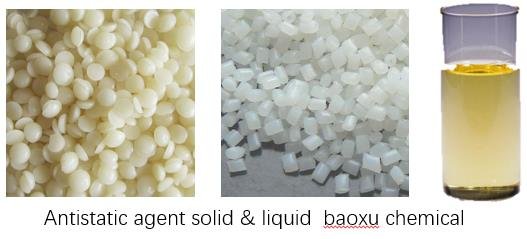 Introduction – What is antistatic agent additive
The purpose of using antistatic agents in polymers is to reduce the static electricity build-up. Thus avoid dust attraction, and film sticking as well as safe spark-free handling of the plastic articles. They are used in polyolefin polymerization processes to reduce static build-up inside different reactor systems, also plastics like BOPP film, PVC, PP, PE, ABS, PS, and PET. In agriculture, packing, and petrochemical applications.
Antistatic Additive by Type
Antistatic Agent by acting time
Permanent Antistatic or we say long-lasting. or short-term antistatic.
Antistatic Agent by function
Antistatic agents can are divided into two general categories, internal and external antistatic additives.
Types & features of antistatic agents
| type | migratory additives | permanent antistatic | conductive carbon black/nanotube |
| surface resistivity level | Antidust to ESD | Antidust to ESD | Conductive |
| humidity dependent | Yes | No | No |
| typical dosage | 0.2-2% | 7-20% | 3-10% |
| resistance level range | 109-10 12 | 108-10 14 | 104-105 |
| advantages | • Low dosage | • No bleed-out, No polluting •Perform immediately & long lasting | • Best performance •Lower cost compared with permanent antistatic |
| drawback | • Bleed-out • Performance loss by washing • Short-term effective | • Higher dosage & costs | • Negative impact on mechanical, • Black color only |
Antistatic agent additive by chemical
Antistatic agents can be divided into the following 3 general categories;
- anion antistatic agents
- Cation antistatic agents
- non-ionic antistatic agents
Antistatic agent additive by application
- Antistatic agent for plastics like BOPP file, PP, PE, ABS, PVC,
- Antistatic agent for fiber
- Antistatic agent for rubber
- Antistatic agent for coating
Antistatic agent additive by market
- Antistatic agent for E&E industry
- Antistatic agent for the packaging industry
Antistatic agent additive product form
- Liquid
- Pellet
- Masterbatch
- Paste
- Powder
Specifications of Antistatic Additives
| Item name | Description | Form | Compare as | Type |
| BX ATA 129 | Glyceride | white powder | Atmer 129 | short term |
| BX ATA 163 | Ethylamine oxide | liquid | Atmer 163 | short term |
| BX ATA 1800 | Ethoxylated amine | white solid | Armostat 1800 | short term |
| BX ATA 300 | Ethoxylated amine | yellow paste | Armostat 300 | short term |
| BX ATA 400 | Ethoxylated amine | slight yellow solid | Armostat 400 | short term |
| BX ATA 600 | Ethoxylated amine | white solid | Armostat 600 | short term |
| BX ATA 93 | Sodium alkyl sulfate | light yellow pellets | HOSTAPUR SAS 93 | short term |
| BX ATA P100 | thermoplastic polyamide elastomer blends(TPAE) | natural color particles | PEBAX MH 1074 PEBAX MV 2080 | permenent |
| BX ATA P200 | thermoplastic polyamide elastomer blends(TPAE) | natural color particles | PEBAX MH 1657 PEBAX MV 2030 | permenent |
Package
Varies due to product forms
Things to know about short-term antistatic agents
- Humidity: Irrespective of the additive used, humidity has an impact on anti-static performance. At low humidity (<30% RH), the anti-static performance will start to deteriorate rapidly as there is not enough water in the atmosphere to easily form a conductive film with the anti-static on the surface.
- Presence of other additives: The performance of anti-static additives can be affected by both inorganic fillers and pigments which may adsorb the additive onto their surface, restricting migration of additive to the surface. Other migratory additives such as slip and anti-fog, may also compete at the surface and reduce the anti-static effect. It is important to trial the additive system in a formulation representative of the final application, as addition levels may need to be adjusted to give the correct balance of properties in the end product or application.
- Other process variables that may affect anti-static performance are corona treatment, high winding tension, and laminated film layers. All of these variables can impact the migration properties of additives reducing the capability of the additive to perform.
Storage
BX antistatic agent shelf life is 1-2 years in cool and dry conditions
.
Brochure
plastic additive brochure baoxu chemical
Sample and Inquiry
Please contact our online sales or mail at info@additivesforpolymer.com for a sample and general inquiries.